

"Go where your competitors can't - or won't."



Where the good stuff starts to come together.

This is where we take every thought-provoking observation that has come out of the Honesty Box process and do some initial creative thinking to see where they might lead.
We don’t create fully worked up ads at this stage. It’s about developing first thoughts to the point where they can be discussed as loose concepts with the client verbally.
The whole idea of Goody Bags is to provide our clients, and ourselves, with as much embryonic material to work with in the future as possible.
Anything that we identify as being strategically different, or creatively appealing, goes into the Goody Bag.
This allows future marketing strategy discussions to be based not just on rational considerations alone, but also on how impactful the creative executions could potentially be.
And this is crucial, because it leads to the next step in the process: what’s going to be asked for in the brief.
It isn’t about finding perfect solutions.
Because they’ve almost certainly been done.
It’s about finding outstanding imperfect ones.
Because they hopefully haven’t.


The main benefit of our approach is that by the time we’ve been through the Honesty Box and Goody Bag processes everyone should have a good idea of a number of routes that are worth exploring.
Not only will we have agreed where the gaps or potential overtaking lanes are, some initial creative thinking will have already been done to suggest how we could take advantage of any openings.
Because creatives have been involved in the whole process right from the start, all they really need from the brief is written confirmation of which route we’ve chosen to go down now.
But of course, creative briefs aren’t just about steering creative output.
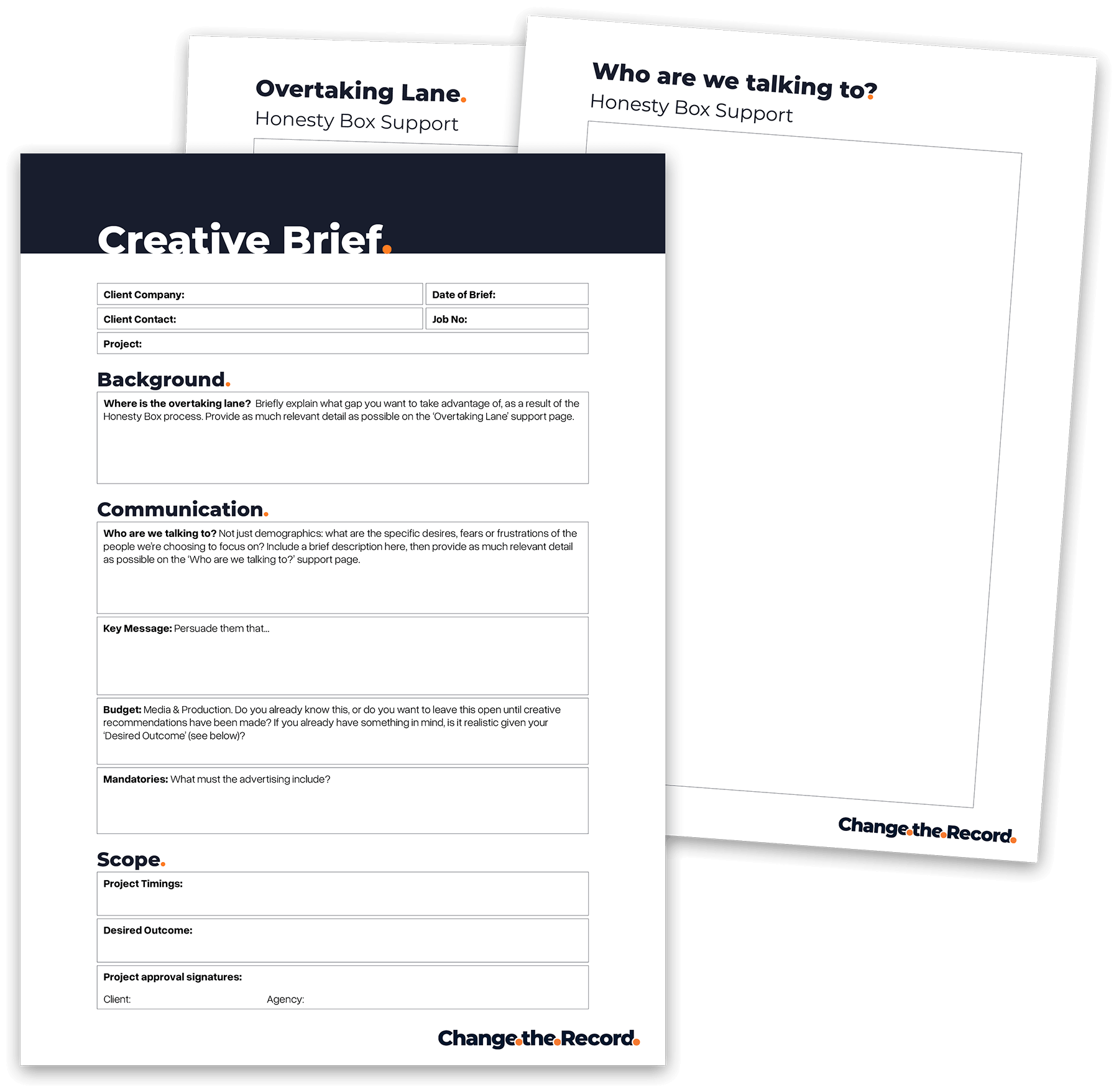
They’re about informing all stakeholders - some who won’t have been privy to the earlier part of the process - about what we’re planning on doing, and why. Which is why we still include a formal creative brief in our process.
You can see ours below.
